

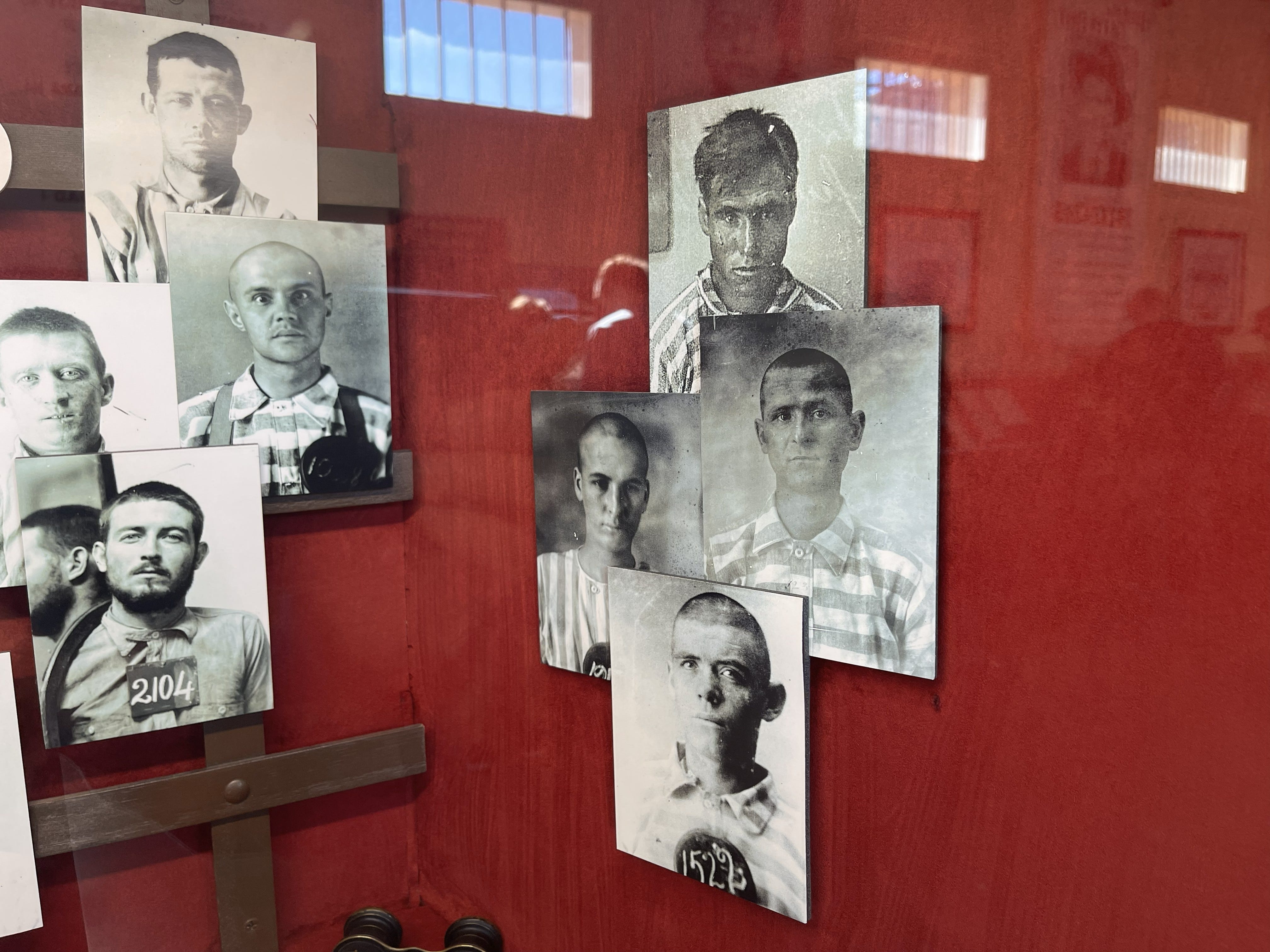
In my trip over Thanksgiving, I visited the Yuma Territorial Prison State Historic Park. The prison operated from 1876 to 1909, and the site is maintained to show what it was like to be a prisoner in blazing-hot Yuma, Arizona (well into the 100s during the summer).
It was eerie to see, throughout the park, the faces of prisoners strewn about on displays, mannequins posed inside cells, and storyboards. These photos came from their mug shots—likely their first experience with a camera. Frozen in time, they remain for tourists to learn about the horrible crimes these men and women committed at that point in their lives.
I found myself wishing there were a way for them to turn things around. But there wasn’t. It had already happened. They stare back in their black-and-white photos, holding regret and despair in their eyes and their prisoner number in their hands. Their choices, on display for eternity.
A year after the prison closed, a new school—Yuma High School—decided to call the abandoned prison home for four years until a proper building could be funded. To this day, the school’s mascot is—believe it or not—the “Criminals.” You can see a photo of an early class here (scroll to the bottom).
I tried to remember the people at my own high school. The faces I recalled slid into view one after another. They too were frozen in time. Our young faces were filled with smiles and hope, just at the beginning of adult life, setting out for a grand adventure. If we were lucky, we did so with just the right balance of knowledge and direction. The lack of information compared to today feels nostalgic—there was no Internet or AI back then.
I cannot imagine growing up in today’s connected universe. The amount of information and technology surrounding us on a daily basis is exhausting. I think I would go mad.
During the trip, I finished Against the Machine by Paul Kingsnorth. On page 270, he discusses what must be done to save Western civilization from itself. Before he provides his answer, he declares: “‘The West’ is the kingdom of Mammon.” I didn’t know what that meant, and the phrase stuck with me.
At Starbucks the next day, I noticed a man—probably in his early thirties—with a dozen books, clothes, papers, and notebooks scattered across his seating area. He was feverishly writing with one hand while his other hand stretched across English and Hebrew words in a book.
“You look quite busy,” I said.
He walked over and immediately began talking about Mammon destroying our society. What are the chances that the very subject I had been pondering would appear again? This was no coincidence. I didn’t know if he was crazy or brilliant and, after talking with him, I’d say a little bit of both. His name was David.
David said Mammon is the replacement of God with money. And it is avarice that drives men to seek Mammon, as depicted in the Fourth Circle of Dante’s Inferno—the Circle of Avarice. He took about five minutes to jot down notes he was eager to share. He told me he had been sitting there for two weeks and no one had spoken to him. He was elated.
That night, while finishing Kingsnorth’s book, I had an epiphany: avarice is one of the seven deadly sins that feeds our choices. Kingsnorth says our battle against the Machine (what I now interpret as avarice within ourselves) must be fought from within—through self-moderation—or by removing ourselves from the Machine as much as possible (though never entirely).
I believe David has removed himself from the Machine, albeit, still sitting in a Starbucks. As I’ve written before, moderation is the key to defeating the Machine. But what that really means is that we must defeat avarice to do so—to escape the Fourth Circle of hoarding and wasting—and simply give.
The Machine, Mammon, will always remain inside us. Yet we are far wiser now than the high-school versions of ourselves. We aren’t the Yuma prisoners, destined to be known for our poor choices for all eternity.
Each of us is the hero of our own great adventure. We still have time to make the right decisions. Just throw the ring in the lava and save Modern Earth. With and in Christ, we can do anything.
Peace.